
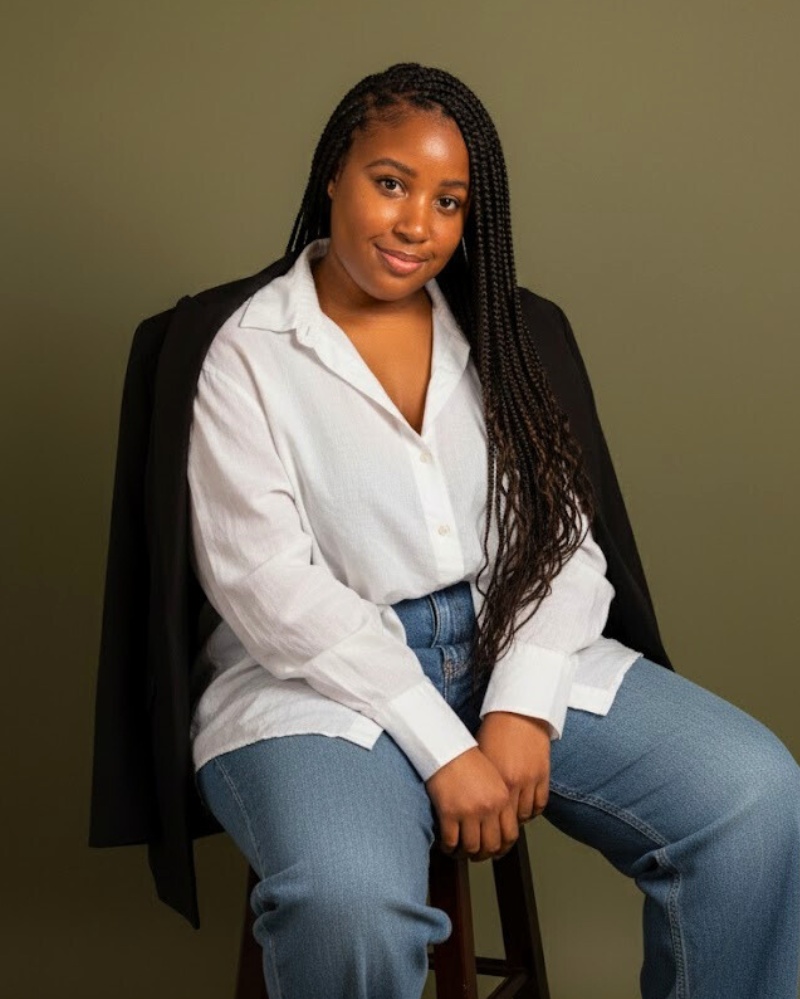

Fe Noel, Nichole Lynel, TIER, and Charles Harbison are all names that I have come to know, love, and support because of Brandice Daniel and the work she’s done to champion Black and brown designers through her companies, Harlem’s Fashion Row (HFR) and ICON360.
“Sometimes all we got to do is show up,” Daniel said with confidence while preparing for her feature interview as the cover star of BrownStyle Magazine’s September digital issue. Despite preparing for Harlem’s Fashion Row’s 19th Annual Fashion Show & Style Awards, the CEO carved out time from her busy schedule and showed up with intention for her first cover story. Rocking her signature blonde hair, the Memphis, Tennessee beauty glowed as she talked all things fashion, diversity, and building genuine relationships.
“One of the things I’ve been super intentional about is building real relationships with people,” the founder shares, noting her agency helps designers grow through brand strategy, collaborations, marketing, and pipeline programs. “At HFR, we talk a lot about how we only want to work with good humans—from designers to brands. The work becomes fun when you get to work with good humans.”

Since launching in 2007, Harlem’s Fashion Row has made waves in all areas of fashion— including with the Closet Challenge, which encourages everyone to dedicate at least 10% of their closet to designers of color. “If people dedicated just 10%, do you know how much that would shift? That would be billions of dollars going to designers of color. There’s so much power there,” she notes, adding that Black people spend approximately $29 billion to $40 billion annually on apparel and footwear.
“That’s a lot of economic power! We also have the influence,” she notes, before encouraging celebrities and rappers to highlight Black designers. “The reason brands like FUBU, Rocawear and Sean John did so well in the ’90s was that the culture supported those brands through entertainment, music and actors. We used our collective power to create hundred-million-dollar brands. Why can’t we do that today? We can!”
And the impact cannot be ignored. No matter where you turn, even if you don’t know Daniel by name, you’ve seen her work or met the people she’s championed through her projects like HFR’s Sustainability Forum, which brings Black and brown designers into the sustainability conversation.
“We give designers the resources to become more sustainable, because a lot of times it comes down to having the resources and finances to produce sustainably,” she explains. “A few years ago, we had a designer (Dyandra Raye, founder of Jo-Anne Vernay) making shoes out of pineapple material—creating pineapple leather (Piñatex). This year, we had David Lee creating Vegetable Cashmere®. There’s a lot of innovation happening, and we’re at the forefront of that innovation.”
There’s also the impact on HBCUs. “We now have a program where, if an HBCU student gets an internship in fashion or retail in New York and can’t afford the flight or a place to stay, ICON360 can provide the funding to make that possible. We book those things for them,” Daniel shared with humble pride as she talked about HFR’s ongoing partnerships with historically Black colleges and universities. “That’s the kind of change I’ve always wanted to make. I just never knew how we’d ever get there.”
Ahead, read the full conversation with our September digital cover star as we discuss the origins of HFR, her fashion must-haves, what keeps her motivated, and more!
–
Q: What part has Harlem’s Fashion Row taken in blazing a trail for Black designers and designers of color?
Brandice: If you go back and look at the history of Black people in the fashion industry—Ann Lowe, Jay Jaxon, Stephen Burrows, and so many others—the talent was there. What was missing for a long time was access. HFR creates that bridge.
Now it’s not uncommon for executives at Calvin Klein to see a room full of designers of color in their offices, or for the head recruiter for Nike Design to be at Harlem’s Fashion Row’s Designer Retreat looking for talent.
It’s not uncommon for designers of color to show during New York Fashion Week and be given the resources they actually need to show. [Through our nonprofit, ICON360, we provide the funding to designers to produce their collections.]
It’s not uncommon for brands to reach out and say, “We want to donate toward the designers presenting a collection.” I don’t think that really existed before, and that’s probably what I’m most proud of.
Q: When did you realize HFR was making an impact bigger than you initially expected?
Brandice: It was probably the launch of the Nike LeBron sneaker. That was definitely a moment when I realized, A, we’re making an impact, and B, consumers want to shop designers of color.
I remember being so worried that nobody was going to buy the shoe. I was doing guerrilla marketing. I was literally texting everybody I knew: “Make sure you’re on this app at this time to get this sneaker. We need these sales.”
It was only sold through the SNKRS app, and nobody I knew even had the app downloaded. I was in shock when I found out it sold out in less than five minutes. I didn’t expect it. Apparently, three times as many people on the app were ready to get the sneaker as there were sneakers available. That was the moment.
Q: Was there a moment when you realized, “Fashion is something I want to be involved in for the rest of my life?”
Brandice Daniel: It was my Aunt Margaret. Even saying it, I get emotional. She was really the only person in my family who was so into fashion. She subscribed to magazines like Harper’s Bazaar and Vogue. I would get to her house, and she’d say, “Brandice, I got some new magazines.” I’d sit on the floor flipping through the pages. The photo shoots were so extravagant and beautiful. I would just get lost in those worlds.
My uncle Muga also owned a store called Muga’s Import. He would go to Africa to get clothes. [My cousin and I] would have fashion shows to model the clothes so people would buy them.
I think I had an innate interest, and it was nurtured. I was allowed to get a glue gun and change my shoes and stud out my heels for hours on my porch. I always knew exactly what I wanted to wear to school on the first day and spent so much time picking it out. Fashion has been a part of my passion and my life for a long time.
Q: Why Harlem?
Brandice: The funny thing is, I hadn’t planned on moving to Harlem. I had never even been to Harlem. The only place I had been in New York was Brooklyn because I was part of the natural hair movement way before it was popular, and I would fly to New York to go to Miss Jessie’s in Fort Greene to get Curly Pudding.
The night before I moved from Memphis, I still didn’t know where I would live. I found an apartment on Craigslist in Harlem.
I got to New York on a Sunday, went to my temporary place, put down my bags, got on the subway, and met the guy in Harlem. I literally fell in love with it. I got off the train at 135th Street and walked over to the apartment. It was the first and only apartment I looked at. I said, “Yep, I’m taking it.”
What I loved about Harlem was that it reminded me of home. The guys on the street would literally help me over a puddle of water. It felt so familial to me. Harlem reminded me of family. It reminded me of the people I grew up around.
Q: How does fashion and style serve as forms of community and advocacy?
Brandice: I think we’re realizing more than ever that we have to stick together. We have to have each other’s backs. We have to be intentional about creating spaces where people feel seen.
That is the goal for everything we do from an HFR or ICON360 perspective. We’ve been very intentional from the beginning about creating safe spaces that feel like community and family. Very loving. Very supportive. I hope people see us as a light in this industry. The more we can be light, the more other people might say, “I’m going to be light too,” or, “I’m going to create this type of space as well.”
Q: For allies, what does meaningful support and advocacy for Black/Brown designers, stylists, and creatives actually look like?
Brandice: If you see a talent you like, reach out to them and find ways to support them.
One of the most powerful things an ally can do is use their network to connect people and expand opportunities. Even if there isn’t an immediate opportunity, set up a conversation between an incredible designer of color and someone you know who could potentially be helpful to them.
I’ve been introduced to so many people because of allies. I want to see those same doors opened for designers of color as well. It’s priceless.
Q: Who are some of the fashion architects you want to pay homage to?
Brandice: The person who has probably impacted me the most is Lois K. Alexander-Lane. She created the Harlem Institute of Fashion and the Black Fashion Museum. I know Harlem’s Fashion Row’s work is essentially carrying on her legacy.
She passed away the year I started Harlem’s Fashion Row. Because of her, so much of our history and our work has been preserved. Then there’s Stephen Burrows. We stand on his shoulders. So many things would not even be possible without him.
There’s Gordon Henderson, Jay Jaxon, Isaiah Rankin, and Arthur McGee. When you talk about fashion architects, you also have to mention the costume designers and stylists. People sometimes see them as stylists, but you have to bring up Misa Hylton and June Ambrose, who are both still in the game.
You have to mention the stylists who created so many of these stories that shaped culture for me growing up. Of course, you’ve got Dapper Dan, who finally got some of his just due—but not all of it. There’s still so much we owe to Dapper Dan and so much that he gave us as a culture through his creativity and is still giving us.
Q: You are a champion of HBCUs and their fashion programs. What positive changes have you seen over the years?
Brandice: What I’m really proud of is that we’ve been able to go onto campuses like North Carolina Central, North Carolina A&T, and Clark Atlanta and do programs over several years.
We’ve been working with Clark Atlanta since around 2015, and we’ve been present for them. I’ve known their department head, B.J. Arnett, for all these years. By having real relationships with professors and departments, we’ve been able to see shifts and changes within these students over time.
For example, Kuan [Jackson] from Clark Atlanta, who won the Chairman’s Award for the Fashion Scholarship Fund, is now in Paris. I’m certainly not taking full credit, but I do believe Harlem’s Fashion Row and ICON360’s investment in Clark Atlanta’s fashion department helped show students what’s possible.
That was the thing missing when we first started working with HBCU departments. The students didn’t have hope. Nobody was coming to their schools. They didn’t feel like brands were actually going to recruit them.
All it takes is one or two students being recruited from an HBCU, or one or two students getting an opportunity like Kuan, for all of the students to have something big to strive for in fashion.
Q: How does your personal style make you feel like your highest, most confident, and most divine self?
Brandice: I get to wear the stories of incredible designers. I am wearing a piece right now from K Millie. It’s a beautiful silk dress that almost feels Japanese-inspired. Every time I wear something from a designer of color—which is every day—I know that I’m wearing their stories. Understanding their stories of resilience and perseverance is the thing that motivates me to keep going.
Q: What is your power color?
Brandice: I have this purple coat-jacket collaboration piece that Misa [Hylton] did with Macy’s. It’s my favorite. It’s this plum color somewhere between plum and fuchsia. That’s my power color. I also have a jacket from Kimberly Goldson that I’ve had for 20 years. She actually told me to stop wearing it because I was wearing it too much!
Q: What’s one fashion item you cannot live without?
Brandice: My closet! If I lost my closet, I would go nuts. I love me some Simone I. Smith earrings. I can’t find some hoops right now, and it’s driving me crazy because I love hoops, and hers are some of my favorite earrings. I have a Telfar bag that’s this slouchy black bag, and it’s my go-to. If I couldn’t find that bag, I would definitely go nuts.
Then I have a black-and-white Brandon Blackwood trunk bag. I have to stop myself from wearing it because I honestly want to wear it every day. I also have this blazer by Fe Noel that I wish she would make again. You can literally ball it up, and it doesn’t wrinkle, and it looks great with everything.
Q: If you could give young Brandice advice about venturing into fashion and making a difference, what would you tell her?
Brandice: I would say: Assume everyone wants to help you. Sometimes our perception of people and their intentions can become true. Young Brandice actually assumed people wanted to help her—one of the many reasons HFR has grown.
I would also say to young Brandice, “Yes, girl. The crazy dreams are possible.” The crazy dreams—the dreams that feel out of reach—they are possible. Go on and take that jump.
Q: What message would you want to leave for future Brandice?
Brandice: To my future self, I hope I can say, “Thank you for taking all the cliff jumps, because we have no regrets.” That’s what I hope I can say. I think about future Brandice a lot. I never want to regret anything. If God gives me something to do, I want to do it—or at least put all of my effort towards doing it. I don’t want to have any regrets about the things I did not do.
Q: If you could describe your hope for the future of HFR, what would it be?
Brandice: Where we’re headed right now is something we’re calling “The Studio.” I don’t know if it’s going to be called HFR Studio, but it will be under HFR, and we’ll be building out core-item businesses for designers of color.
The future I see is getting to $100 million in revenue for designers of color. I want to see designers benefit economically in this industry. They’ve had tons of press and visibility, and now we’re seeing more access when it comes to partnerships. Where there is still a lot of opportunity is in economic success for designers of color. If we can build out 10 businesses making a minimum of $10 million each, that will be success to me.
